Kubernetes Deployments vs StatefulSets: Key Differences
Chafik Belhaoues
Imagine you’re just getting started with Kubernetes. Sooner or later, you’ll inevitably ask yourself: which should you use for a specific application - a Deployment or a StatefulSet? The choice isn’t always easy, since both manage deployments and ensure that the right number of instances is running. But you still have to choose between them.
Deployment vs. StatefulSet is a choice between two fundamentally different models: an application that doesn’t care which pod it runs on, and an application for which the identity of each instance matters. Understanding this difference can be tricky, but once you make the right choice for your needs, you’ll get the best possible results. Kubernetes Deployment vs. StatefulSet - a topic where a wrong choice can be costly, and the Brainboard team is here to help you solve this problem right now.
What Deployments and StatefulSets Have in Common
Before we dive into the differences, we need first to understand their similarities. The fact is, there are enough similarities to make the confusion understandable.
Kubernetes StatefulSet vs. Deployment - both controllers manage the lifecycle of pods. They support scaling: if you want more replicas, you change the number, and Kubernetes creates the pods. Both also perform rolling updates - gradually updating the application without downtime. And together, they maintain the desired state: if a pod goes down, the controller recreates it.
These are the basic responsibilities of any workload controller in Kubernetes. The difference begins where this common ground ends. Specifically, the difference lies in how pods are created, named, store data, and are deleted.
How a Kubernetes Deployment Works
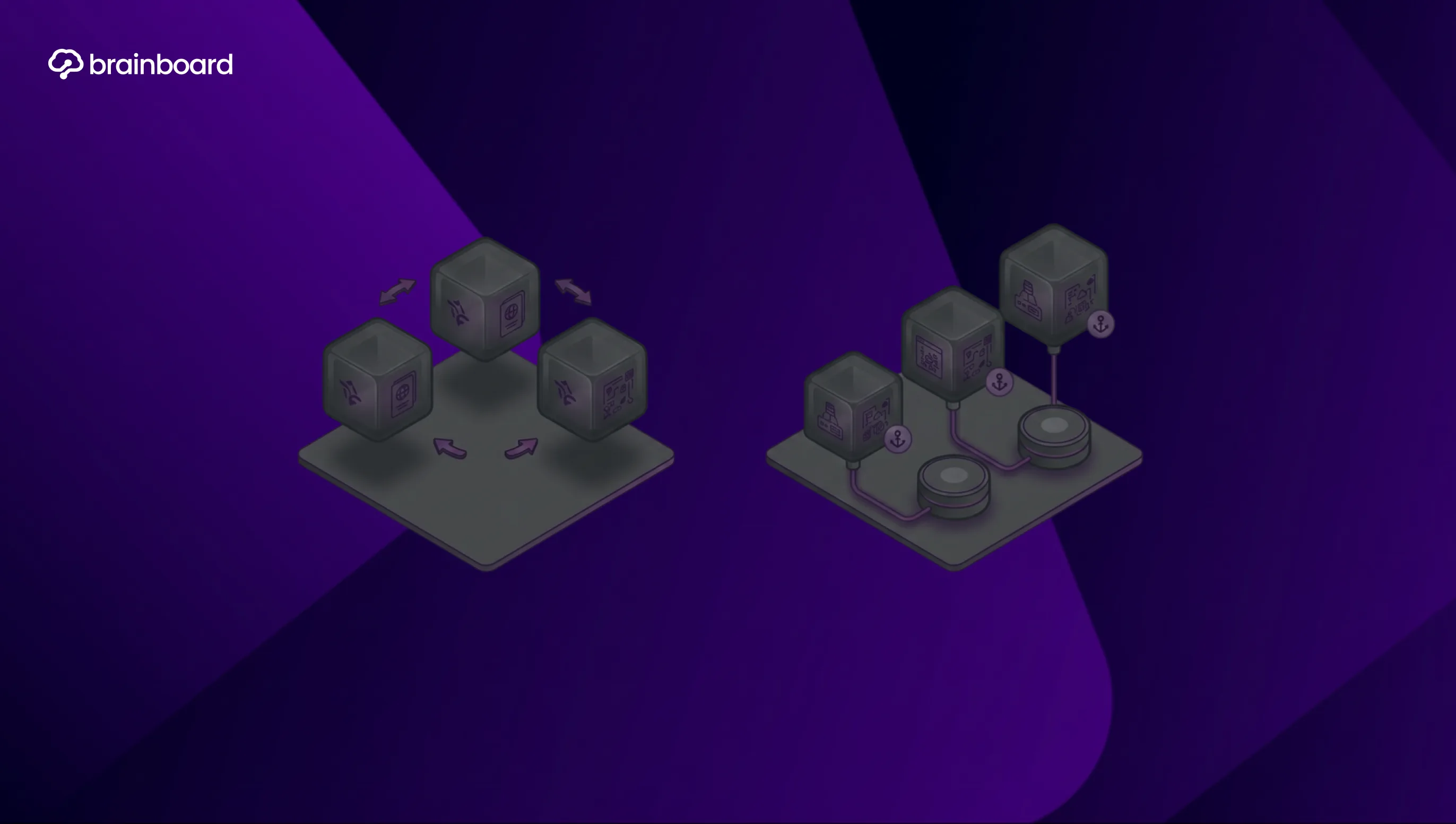
A Deployment is the standard way to run a stateless application. The logic is simple: there is a set of identical pods, any of which can handle any request, and it doesn’t matter which specific pod does it.
A Deployment manages a ReplicaSet - an object that monitors the number of running replicas. When the image is updated, a new ReplicaSet is created, and new ones gradually replace the old pods. During a rollback, the process is reversed.
K8s StatefulSet vs. Deployment begins right here: A Deployment does not provide pods with stable names. Pod-abc123 died, then pod-xyz789 appeared. For a stateless application, this is normal: the load balancer will simply route traffic to the live pod. For a database, this is a disaster, because the other nodes in the cluster no longer know how to communicate with it.
Deployment is the right choice when pods are interchangeable, and the application does not maintain local state between requests.
How a Kubernetes StatefulSet Works
Kubernetes StatefulSet solves a fundamentally different problem. It is designed for applications where each instance is not just a copy, but a specific participant in the system with its own role.
Three key things that StatefulSet guarantees and Deployment does not.
- Stable names. Pods are given predictable names: app-0, app-1, app-2. After recreation, the name is retained. app-0 will always be app-0 - this is important for cluster applications where nodes know each other by name.
- Ordered deployment. Pods are created sequentially: first app-0, then app-1, and only when the previous one is ready. Deletion occurs in reverse order.
- Persistent storage for each pod. Each pod receives its own PersistentVolumeClaim, which is not deleted when the pod is recreated. app-0 always works with its own data.
Key Differences Between Deployments and StatefulSets
StatefulSet vs. Deployment differ, and we have identified 5 main differences between them:
- Load type. Deployment is for stateless applications, StatefulSet is for stateful ones. This is a fundamental distinction on which everything else depends.
- Pod identity. In a Deployment, pods are anonymous and interchangeable. In a StatefulSet, each pod has a stable name and network identifier.
- Storage. A Deployment typically uses shared storage or no storage at all. A StatefulSet allocates a separate PVC to each pod.
- Order of operations. A Deployment creates and deletes pods in parallel. A StatefulSet does so strictly sequentially.
- Updates. Both support rolling updates, but in StatefulSet, the order of pod updates is also strictly enforced.
Deployment vs. StatefulSet is not a question of “which is better,” but a question of “which is suitable for a specific task.”
Pod Identity, Storage, and Scaling Compared
The difference between Deployment and StatefulSet is particularly evident in three specific areas:
- Identity
For a Deployment, a pod is a disposable resource. If one dies and another appears with a new name, the application doesn’t care. For a StatefulSet, a pod is a specific participant in the system. A PostgreSQL replica knows its master by name. A Kafka broker knows its neighbors. Losing a name means losing a role in the cluster.
- Storage
In Kubernetes StatefulSet vs. Deployment, this is the most noticeable difference. StatefulSet creates a separate PVC for each pod via volumeClaimTemplates. When a pod is recreated, it mounts the same volume with the same data. In Deployment, there is no such guarantee.
- Scaling
Adding a replica to a Deployment is simple: the new pod is no different from the others. In a StatefulSet, a new pod receives the next number and its own volume. Deletion also strictly follows the reverse order - you cannot delete app-0 while app-1 and app-2 are still active.
If you are designing infrastructure with Kubernetes and want to visualize component dependencies clearly, Brainboard visualizes the architecture and generates Terraform code automatically.
When to Use a Deployment
StatefulSet is not needed where pods are interchangeable. Deployment is the right choice for:
- Web applications and frontends - any pod serves the same content, and the load balancer distributes traffic evenly.
- REST APIs and microservices - a request arrives, is processed, and leaves. There is no local state; a different pod can handle the next request.
- Workers and queue processors - they take a task from the queue, execute it, and return the result. Which specific worker it is doesn’t matter.
- Anywhere where horizontal scaling involves simply adding another copy, Deployment handles it perfectly.
When to Use a StatefulSet
K8s StatefulSet vs. Deployment leans toward StatefulSet when it matters to the application exactly which instance it is.
Databases - PostgreSQL, MySQL, MongoDB. Each node stores its own data; replicas know the master by name.
Distributed systems - Kafka, ZooKeeper, Elasticsearch, Cassandra. Cluster nodes communicate directly with each other and identify one another by persistent names.
Kubernetes StatefulSet is needed wherever: pods store unique data, system nodes address each other by name, and the order of startup and shutdown matters for correct operation.
Common Mistakes When Choosing Between Them
Deployment vs. StatefulSet - a choice where mistakes are costly, and the most common ones are:
- Deployment for a database. A classic beginner’s mistake. A database in a Deployment consists of pods without persistent names and without a guarantee that, after recreation, the pod will connect to the same data. At best, you will lose data. At worst, silent inconsistencies that will be discovered in production.
- StatefulSet for a stateless service. The opposite mistake is less common, but it happens, too. StatefulSet adds unnecessary complexity: sequential scaling slows down deployment, and separate PVCs are created in vain. A simple API does not need an ordered deployment.
- Ignoring the headless service. StatefulSet requires a headless service for stable DNS resolution of pods. Forget it - and stable names stop working as expected.
Designing a Kubernetes architecture with these dependencies in mind is easier visually. Brainboard shows the connections between components and helps ensure you don’t miss important details during design.
FAQ
Can I use a Deployment for a database in Kubernetes?
Technically, yes. Practically, it’s a bad idea. There is no guarantee of persistent storage or pod identity, which leads to data loss upon recreation.
What happens to data when a StatefulSet pod is deleted?
The PersistentVolumeClaim is preserved. When the pod is recreated with the same name, it mounts the same volume with the same data.
What is the difference between a StatefulSet and a ReplicaSet?
A ReplicaSet is a low-level controller managed by a Deployment. A StatefulSet is a standalone controller for stateful workloads with guarantees of identity and storage.
Do StatefulSets need a headless service?
Yes. A headless service (with a clusterIP: of None) provides stable DNS names for each pod in a StatefulSet.
Can I convert a Deployment to a StatefulSet without downtime?
Without downtime, it’s difficult. You need to create a new StatefulSet, migrate the data, and switch the traffic. This is a migration, not a simple object replacement.

.webp)
.webp)
.webp)


.webp)
.webp)
.webp)
.webp)
.webp)