Cloud Deployment Models in Cloud Computing in Real Scenarios
Chafik Belhaoues
Today, nearly every business uses the cloud in some way. But the “cloud” is not a one-size-fits-all solution. Behind this term lies a whole spectrum of approaches to how data is stored, where applications run, and who has access to them. Cloud deployment models in cloud computing are a fundamental concept that defines the architecture of your cloud environment. The model you choose determines how flexibly you can scale, how secure your data is, and how much the entire infrastructure costs.
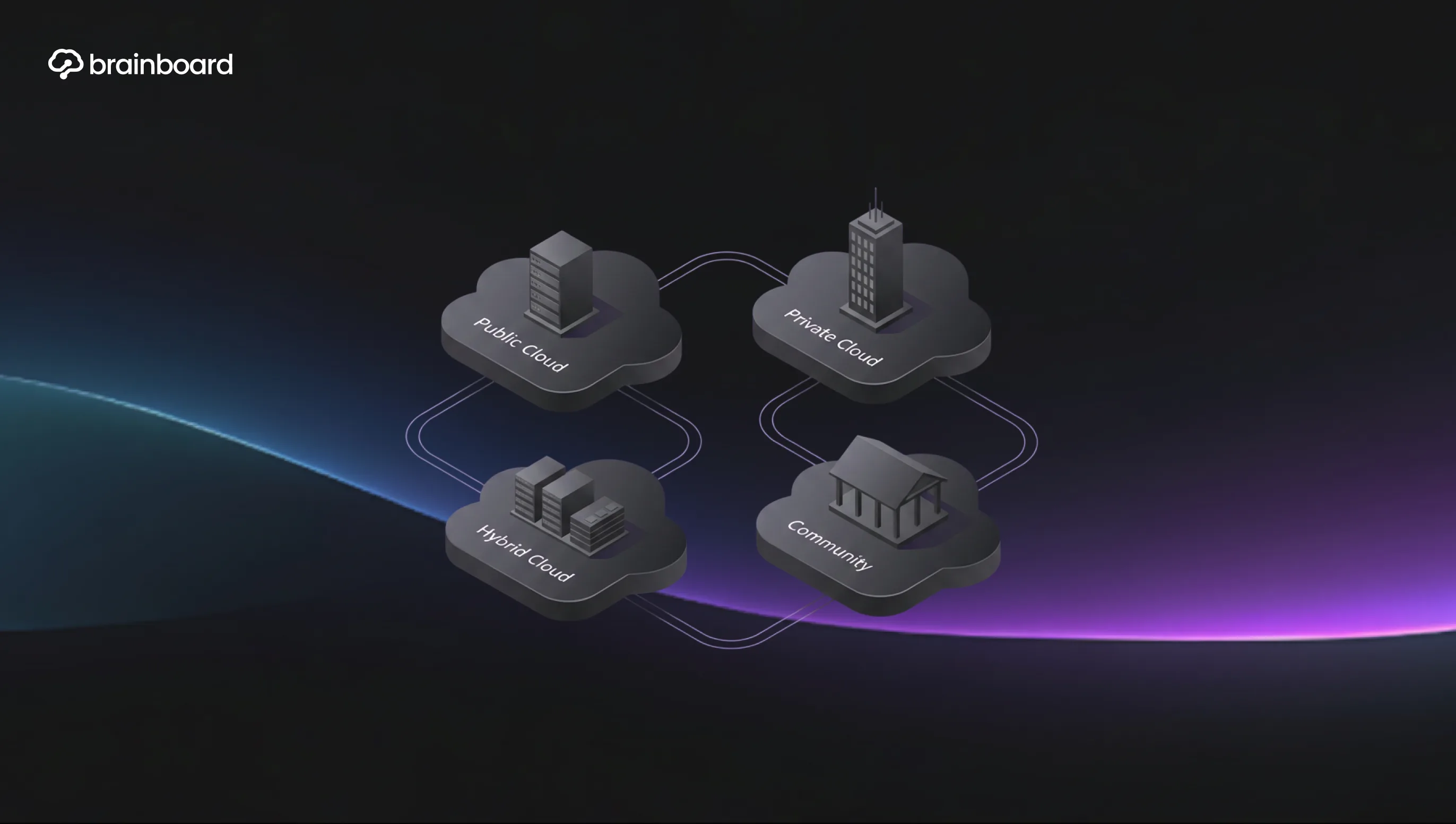
There are four main cloud models: public, private, hybrid, and community. Each addresses different needs and is suited for different scenarios. For example, a startup launching a mobile app and a bank processing financial transactions operate in completely different sectors. Consequently, each will choose fundamentally different approaches - and both will be correct.
The Brainboard team has been successfully working in cloud deployment for many years. We know all the nuances better than anyone else and will help you navigate this field to find the solution that’s perfect for you.
What Are Cloud Deployment Models?
Cloud deployment models describe exactly how a cloud environment is organized: who owns the infrastructure, who has access to it, and how security is managed. The choice of model directly affects four key parameters:
- Security - where data is physically stored and who has access to it.
- Scalability - how quickly and easily capacity can be scaled up.
- Control - how much detail you have in managing configuration and security policies.
- Cost - capital expenditures for your own infrastructure vs. operating expenses for cloud services.
Understanding these models is the starting point for any cloud strategy. Making the wrong choice at the outset can lead to high costs and complications down the road.
Public Cloud Deployment Model
Public cloud deployment model - the most common and, perhaps, the easiest to understand model. The infrastructure belongs to a major provider - AWS, Microsoft Azure, Google Cloud - and is used by many customers simultaneously. You don’t buy servers; you rent computing power as needed.
Key features of the public cloud: high scalability, low entry barrier, and a pay-as-you-go model. Want more power? You get it in minutes. Has the load dropped? You pay less.
Real-world use cases:
A startup launches a web application. There’s no point in buying servers - you don’t know what the load will be. The public cloud lets you start with minimal resources and scale as your audience grows.
A SaaS company provides a product to thousands of customers worldwide. The provider’s global network of data centers ensures low latency for users anywhere on the planet.
A mobile app with unpredictable traffic spikes - such as a food delivery app during lunch and dinner - is ideally suited for a public cloud deployment model with automatic scaling.
Limitations: Data is physically stored on shared infrastructure, which can create challenges for organizations with strict compliance requirements. For banks or healthcare systems, this may be unacceptable.
Private Cloud Deployment Model
Among cloud deployment models examples, a private cloud is a dedicated environment used by a single organization. The infrastructure may be physically located in the company’s own data center or at a hosting provider, but the key feature is complete isolation from other users. A private cloud is chosen when security and control are more important than cost.
Who uses it and why:
Banks and financial institutions are required to comply with strict regulatory requirements. Customer data, transactions, and credit histories - none of this can be stored in a shared infrastructure. A private cloud provides complete control over who accesses the data and how.
Government agencies work with classified or sensitive data. Storing such data in a public cloud is often explicitly prohibited by law. A private cloud environment is the only acceptable option.
Large healthcare systems store patients’ personal data, test results, and medical histories. HIPAA, GDPR, and other regulatory requirements make the private cloud the industry standard.
What to consider: A private cloud is significantly more expensive than a public cloud. You bear all costs for equipment, support, and infrastructure updates. Scaling is also limited by physical capacity. This is a conscious trade-off between control and flexibility.
Hybrid Cloud Deployment Model
The hybrid cloud is perhaps the most interesting model because it reflects the reality of most large companies. Different deployment models in cloud computing rarely exist in their pure form: businesses combine them to get the best of each approach.
The hybrid model combines private and public clouds into a single environment, enabling data and workloads to be moved between them.
How this works in practice:
A large retailer stores its customer database and financial reports in a private cloud, where security is maximized. Meanwhile, the website and app run in the public cloud, allowing them to scale automatically during seasonal sales. Black Friday? The load is tens of times higher than normal, yet the public cloud handles it without issue.
A manufacturing company runs analytics and machine learning on the public cloud, where specialized GPU instances are available, while storing blueprints and intellectual property in a private cloud.
Advantages of the hybrid approach: flexibility in load management, cost optimization (expensive resources are used only when needed), and reliable disaster recovery. If the private infrastructure fails, critical services switch to the public cloud.
Designing a hybrid infrastructure is no small task. Brainboard allows you to visually design such an architecture and automatically generate Terraform code for any cloud provider, avoiding manual errors when configuring connections between environments.
Community Cloud Deployment Model
The community cloud is the least well-known of the four models, but it is indispensable in certain industries. It is a shared infrastructure used jointly by several organizations with similar requirements, tasks, or regulatory obligations.
Imagine a consortium of universities that jointly fund and use a single computing platform for scientific research. Or a network of hospitals that collaboratively deploy a secure environment for exchanging medical data in compliance with regulatory requirements.
Cloud deployment models of this type offer participants several key benefits:
- Shared infrastructure costs
- Common security and compliance policies
- Opportunities for collaboration while maintaining the data isolation of each organization
Examples: Government agencies in a single region jointly use a secure platform for data exchange. Financial institutions create a shared environment for compliance verification, reducing individual costs.
Types of Deployment Models in Cloud Computing Overview
If you’re looking for minimal upfront costs and maximum deployment speed, the public cloud is the right choice. If security and full control are more important than cost, a private cloud is preferred. If you need flexibility without compromising security for sensitive data, choose a hybrid cloud. If you operate in an industry with strict regulations and are willing to share costs with peers, choose a community cloud.
Types of deployment models in cloud computing are not competitors but tools. The right choice depends on specific business objectives, security requirements, and budget. Many mature companies eventually evolve from a simple to a more complex model as their requirements grow.
Cloud Deployment Services Explained
Cloud deployment services are tools and platforms that make cloud deployment manageable rather than chaotic.
This category includes: deployment automation systems (Terraform, Ansible, Pulumi), container orchestration platforms (Kubernetes), CI/CD pipelines, and monitoring and configuration management tools.
Without these services, even a well-designed cloud architecture becomes difficult to manage reliably: manual deployments, inconsistent configurations across environments, and a lack of audit trails.
Modern cloud deployment services work on top of any of the four deployment models. Terraform deploys infrastructure equally well on AWS, Azure, and GCP - and that’s exactly what makes it the de facto standard. Brainboard goes a step further: it lets you visually design infrastructure and generate ready-to-use IaC code compatible with any provider.
Cloud Deployment Solutions in Real Business Scenarios
Theory is fine, but it’s important to understand how cloud deployment solutions work in real business scenarios.
- E-commerce during peak load periods. A large online store uses a hybrid model: the product catalog and transactions are in a private cloud, while the frontend and CDN are in a public cloud. During sales events, the public portion automatically scales to handle thousands of additional requests per second. Once the promotion ends, resources are released, and costs return to normal.
- Fintech and transaction security. Payments are processed by a fintech business in a private cloud, where card information is segregated and safeguarded in compliance with PCI DSS. Maintaining such hardware in an on-premises data center is more expensive than running fraud analytics and machine learning models on powerful GPUs in the public cloud.
- Media platforms and global content. A streaming service stores content and user data on servers in specific regions (to meet data localization requirements), while CDNs and video delivery servers are located in the public cloud worldwide. A user in Tokyo receives content from the nearest node with minimal latency.
Choosing the right deployment model is one of the most impactful infrastructure decisions a business can make. Whether you're just moving to the cloud or rethinking an existing setup, Brainboard helps you design, visualize, and deploy your architecture with confidence - across any cloud provider, any model.

.webp)
.webp)
.webp)


.webp)
.webp)
.webp)
.webp)
.webp)